Schools, childcare providers, and professionals working with children strive to create safe, supportive environments. Yet, when communication with co-parents is inconsistent, unclear, or one-sided, they risk creating confusion, conflict, and unintended harm to the very childhoods they aim to protect. When both parents are not equally informed and engaged, the impact extends beyond just administrative […]
Read full content
 Schools, childcare providers, and professionals working with children strive to create safe, supportive environments. Yet, when communication with co-parents is inconsistent, unclear, or one-sided, they risk creating confusion, conflict, and unintended harm to the very childhoods they aim to protect.
When both parents are not equally informed and engaged, the impact extends beyond just administrative challenges. It affects the child’s emotional stability, their trust in the school or provider, and their ability to thrive in a learning environment.
This is why clear, structured co-parent communication is not just about reducing professional headaches. It is about safeguarding childhoods.
Continue reading “The Hidden Cost of Inconsistent Co-Parent Communication for Schools, Childcare Providers, and Professionals”
At The Layne Project (TLP) and The Layne Project 4 Families (TLP4Families), we are committed to safeguarding childhoods by providing families with the highest quality support through an intentionally designed, proven infrastructure. We recognized early on that families navigating co-parenting challenges, high-conflict custody situations, and family transitions often experience fragmented and inconsistent support when services […]
Read full content
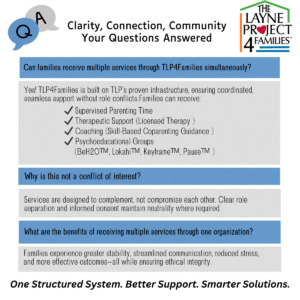 At The Layne Project (TLP) and The Layne Project 4 Families (TLP4Families), we are committed to safeguarding childhoods by providing families with the highest quality support through an intentionally designed, proven infrastructure.
We recognized early on that families navigating co-parenting challenges, high-conflict custody situations, and family transitions often experience fragmented and inconsistent support when services are spread across multiple agencies. To solve this, we built TLP’s unique infrastructure to provide a comprehensive, ethical, and highly coordinated approach to family support.
With TLP’s proven service model as its foundation, TLP4Families will able to deliver wraparound services that minimize barriers to care, reduce stress for families, and create a seamless, supportive experience for parents and children alike. Continue reading “How The Layne Project’s Unique Infrastructure Facilitates Ethical and Effective Wraparound Family Services”
I have a confession: I love me some manifestation. Send out good energy, and that’s what you get back. Joe Dispenza? Yes. Bob Proctor? Of course. But recently, I stumbled upon Annie Duke, and let me tell you—she has officially joined my list of professional crushes. Alongside Diane Kander, she’s rocking my world with a […]
Read full content
 I have a confession: I love me some manifestation. Send out good energy, and that’s what you get back. Joe Dispenza? Yes. Bob Proctor? Of course. But recently, I stumbled upon Annie Duke, and let me tell you—she has officially joined my list of professional crushes. Alongside Diane Kander, she’s rocking my world with a different kind of thinking.
At first, I resisted. Wait, what? Is she saying positive thought is bad? Don’t do it, Trina. Don’t get pulled in. Read on. Don’t get polarized. Challenge your perspective. You’ve got this, Trina. Read on. And so I did.
And what I found was beautiful—not a rejection of positive thinking, but an expansion of it. A balance. A BeH2O moment. It’s not about choosing between optimism and realism, between manifestation and preparation. It’s about both.
Continue reading “The Art of Manifesting with Eyes Wide Open – What Annie Duke Taught Me About Mental Contrasting and Co-Parenting”
Separation is one of the most stressful life events for families—but what’s often overlooked is the financial strain that follows. Many assume that financial hardship only affects families living in poverty, but a much larger group—ALICE (Asset-Limited, Income-Constrained, Employed) families—are struggling as well. These are hardworking families earning too much to qualify for aid but […]
Read full content
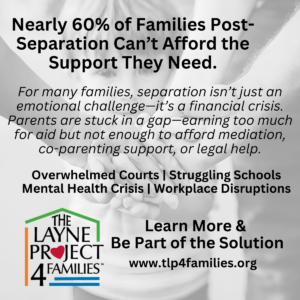 Separation is one of the most stressful life events for families—but what’s often overlooked is the financial strain that follows.
Many assume that financial hardship only affects families living in poverty, but a much larger group—ALICE (Asset-Limited, Income-Constrained, Employed) families—are struggling as well. These are hardworking families earning too much to qualify for aid but not enough to afford essential services like mediation, co-parenting support, and legal assistance.
And when separation happens, their financial situation worsens significantly.
Continue reading “The Financial Toll of Separation: A Crisis Families Can’t Afford”
Sometimes, we find exactly what we need before we even know we need it. That’s what happened when I stumbled upon Annie Duke’s work on decision-making. I wasn’t looking for a decision-making strategist. I was looking for support for BeAligned, my SaaS platform. But somehow, I found myself diving into her research on how our […]
Read full content

Sometimes, we find exactly what we need before we even know we need it.
That’s what happened when I stumbled upon Annie Duke’s work on decision-making. I wasn’t looking for a decision-making strategist. I was looking for support for BeAligned, my SaaS platform. But somehow, I found myself diving into her research on how our beliefs shape our choices, how we navigate uncertainty, and how we don’t need to know everything to make an impact.
And as I read, I realized: This is the missing puzzle piece.
For years, I’ve been on a journey of unexpected discoveries—each one transforming not just my business, but my approach to co-parenting and leadership.
- I didn’t know how to run a business. Then I found Simon Sinek’s Golden Circle, and suddenly I had clarity on my why—not just for my company, but for co-parenting.
- My company culture was struggling. Then I found the Arbinger Institute, and their outward mindset approach reshaped everything, from workplace dynamics to how co-parents interact.
- I needed structure to scale. Then I found the Entrepreneurial Operating System (EOS), which helped me build a framework for business growth—and later, an “operating system” for co-parents.
And now, here I am, reading Annie Duke’s work, and I see how it all ties together.
Continue reading “How Everything is Connected—Even When We Don’t See It”
I looked out the window and saw Mom pull into the parking lot, my heart was beating so fast! I love and miss Mom and can’t wait to hug her! But I’m also mad at her. Why did she fight with Dad? And why haven’t I been able to see her? When Mom got to […]
Read full content
I looked out the window and saw Mom pull into the parking lot, my heart was beating so fast! I love and miss Mom and can’t wait to hug her! But I’m also mad at her. Why did she fight with Dad? And why haven’t I been able to see her? When Mom got to the front door I ran and gave her a hug. She hugged me tight, and we both smiled. Mom and I walk with a woman to a room with a lot of toys. Mom and I play while the woman watches and sometimes writes things down. Mom says she’s happy to see me and be able to play together. I’m happy too, but I’m still a little upset. Before I knew it, it was time to go. Dad was coming to pick me up. Time went by so fast! Mom and I said goodbye and we hugged tight! I watched Mom out of the window as she drove away. I was sad when Mom left but I was also happy I got to see her. It’s okay to feel a lot of things all at the same time. Seeing Mom made me feel sad and happy. I guess you could say I was feeling sappy!
Continue reading “Feeling Sappy: Written from a Child’s Perspective on Supervised Parenting Time”
Supervised Parenting Time (SPT) also often referred to as Supervised Visitation is when a parent in a co-parenting relationship is only permitted to parenting time with their child(ren) under the supervision of another individual. Social workers, counselors, and family members are all examples of individuals who may act as the supervising party. A Supervisor is […]
Read full content
Supervised Parenting Time (SPT) also often referred to as Supervised Visitation is when a parent in a co-parenting relationship is only permitted to parenting time with their child(ren) under the supervision of another individual. Social workers, counselors, and family members are all examples of individuals who may act as the supervising party. A Supervisor is responsible for ensuring the safety of the child(ren) during the parenting time and have the right to interrupt or terminate parenting if the child(ren) involved become(s) distressed or there is a safety concern. SPT can take place at a supervised parenting time facility, a parent’s home, or other public setting. Group supervision, one-on-one supervision, supervised exchange, and therapeutic supervision are all variations of SPT. SPT provides a safe, neutral environment for children and parents to maintain contact and foster family connections in a healthy and safe way despite high conflict situations.
Continue reading “Supervised Parenting Time Basics”
Saboteurs are ways in which we sabotage our wellbeing and relationships. They are the negative voices in our head that generate negative emotions- anxiety, stress, frustration, and unhappiness. Saboteurs are automatic negative thoughts that are very difficult to break! (Positive Intelligence).
Read full content